


You're using good products. Maybe even great ones. A vitamin C serum here, a retinol there, a hydrating moisturiser when you remember. But your skin still feels... off. Not terrible, just not quite right. A bit drier than it used to be. Lines that seem deeper in certain light. That plump, resilient feeling you remember from a few years ago, gone.
Here's what's actually happening: while you're addressing surface symptoms, three basic processes are quietly changing your skin from the inside. And unless your routine tackles all three at once, you're really trying to fill a bucket with holes in it. Let me walk you through what's really going on beneath the surface, and why understanding this changes everything about how you care for your skin.
The Three Silent Processes Changing Your Skin Right Now
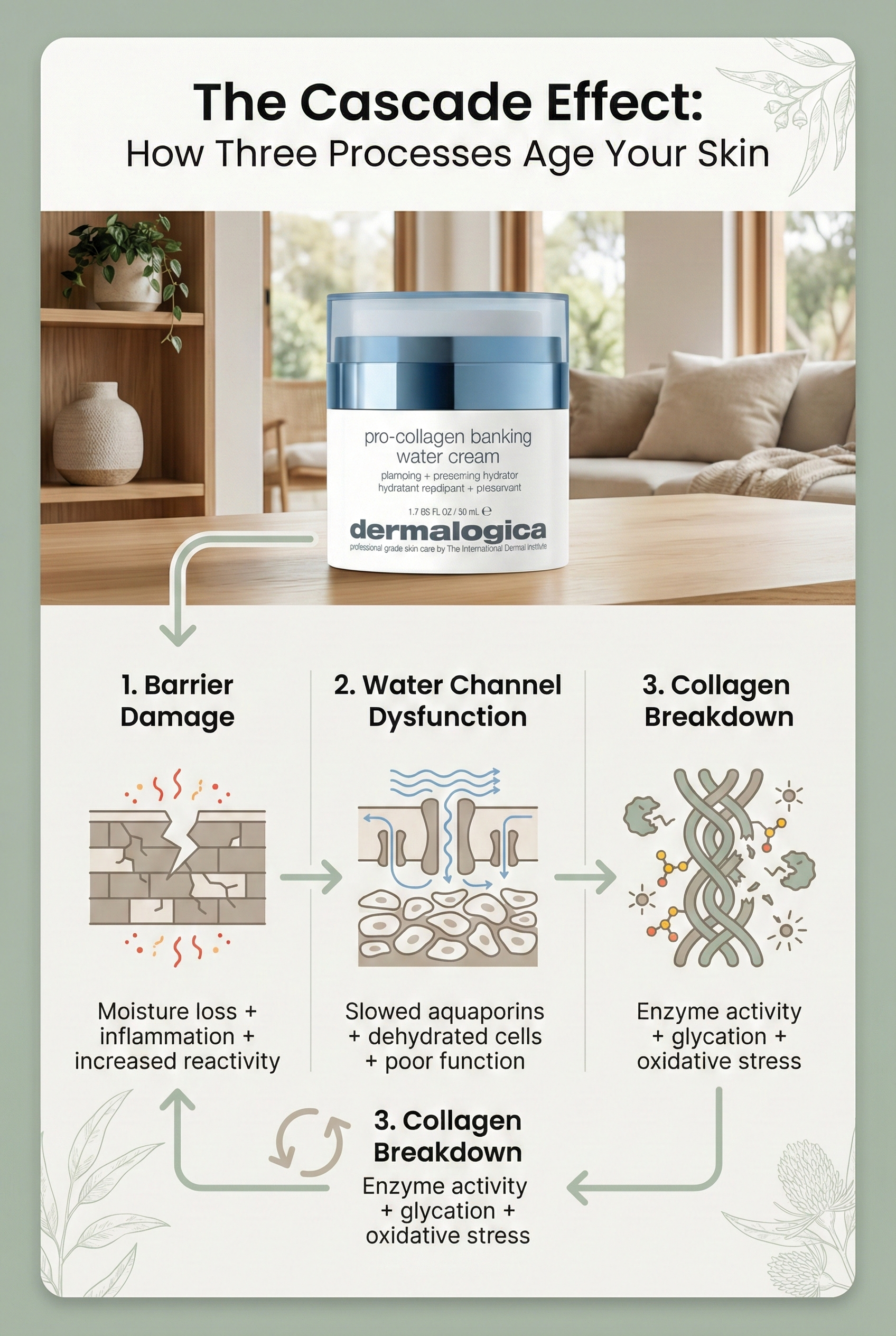
Think of your skin as a building with three critical systems: the protective envelope (your barrier), the plumbing (water channels), and the structural framework (collagen). When you're young, all three systems maintain themselves beautifully. But somewhere in your 30s and 40s, they start breaking down, and here's the crucial bit, they break down at once, each one affecting the others.
Barrier damage is happening constantly. Your skin's outermost layer, the stratum corneum, is made of cells held together by lipids, like bricks and mortar. Every day, this barrier faces assault: UV exposure, pollution, temperature changes, even the water you wash with. When it's compromised, you get transepidermal water loss (TEWL), which is moisture evaporating straight out of your skin faster than you can replace it. This isn't just about feeling dry. A damaged barrier means increased reactivity, swelling, and accelerated ageing. Products that never bothered you suddenly sting. Your skin feels tight by midday even though you moisturised that morning.
Water channel dysfunction is less visible but equally damaging. Your skin cells have tiny channels called aquaporins that transport water from the deeper layers up to the surface. As you age, these channels slow down. It's like your skin's plumbing system losing water pressure. You can slather on all the hydrating serums you want, but if the water can't move through your skin efficiently, you're just treating the surface while the deeper layers remain parched. This is why your skin can feel dehydrated even when you're drinking plenty of water and using moisturiser religiously.
Collagen breakdown is actually three processes happening at once. First, enzymes called matrix metalloproteinases (MMPs) actively break down existing collagen, think of them as tiny scissors cutting the support structure. Second, glycation occurs when sugar molecules attach to collagen fibres, making them stiff and brittle instead of flexible and strong. Third, oxidative stress from UV exposure and pollution damages collagen at the molecular level. Meanwhile, your body's natural collagen production is slowing down. You're losing more than you're making, and what remains is increasingly damaged.
Here's why this matters: these three processes don't happen in isolation. Barrier damage increases swelling, which ramps up those collagen-destroying enzymes. Dehydrated cells can't function properly, which compromises barrier repair. Damaged collagen weakens the skin's structure, making it more at risk to barrier damage. It's a cascade effect, each problem making the others worse.

What This Actually Looks Like in Your Skin
Let me paint you a picture using real examples from my treatment room (details changed, clearly). You might recognise yourself here.
Barrier damage shows up as: That tight, uncomfortable feeling that returns within hours of moisturising. Redness or flushing that appears more easily than it used to. Products that worked for years suddenly causing stinging or irritation. Dry patches that no amount of moisturiser seems to fix. Makeup sitting differently on your skin, emphasising texture you swear wasn't there before. You might notice your skin reacts more to weather changes, air conditioning, or even stress.
Water channel dysfunction looks like: Fine lines that appear more prominent by afternoon, even though they're barely visible in the morning. Skin that looks dull and tired despite getting enough sleep. Foundation settling into lines you didn't know you had. That crepey texture around the eyes or on the neck. Your skin might actually look okay when you first apply moisturiser, but the effect doesn't last. It's like pouring water on dry ground, it sits on top rather than soaking in.
Collagen breakdown manifests as: Loss of that bouncy, resilient feeling when you touch your face. Deeper lines around the mouth and eyes that don't smooth out when you relax your face. Sagging along the jawline or under the eyes. Skin that takes longer to bounce back when you press it. That overall loss of firmness and definition you might struggle to articulate but for sure feel when you look in the mirror.
The tricky part? These symptoms overlap and interact.
Why Your Current Routine Might Be Missing It
Most skincare routines are built around addressing symptoms, not systems. And that's not your fault, it's how the beauty industry has taught us to think about skincare.
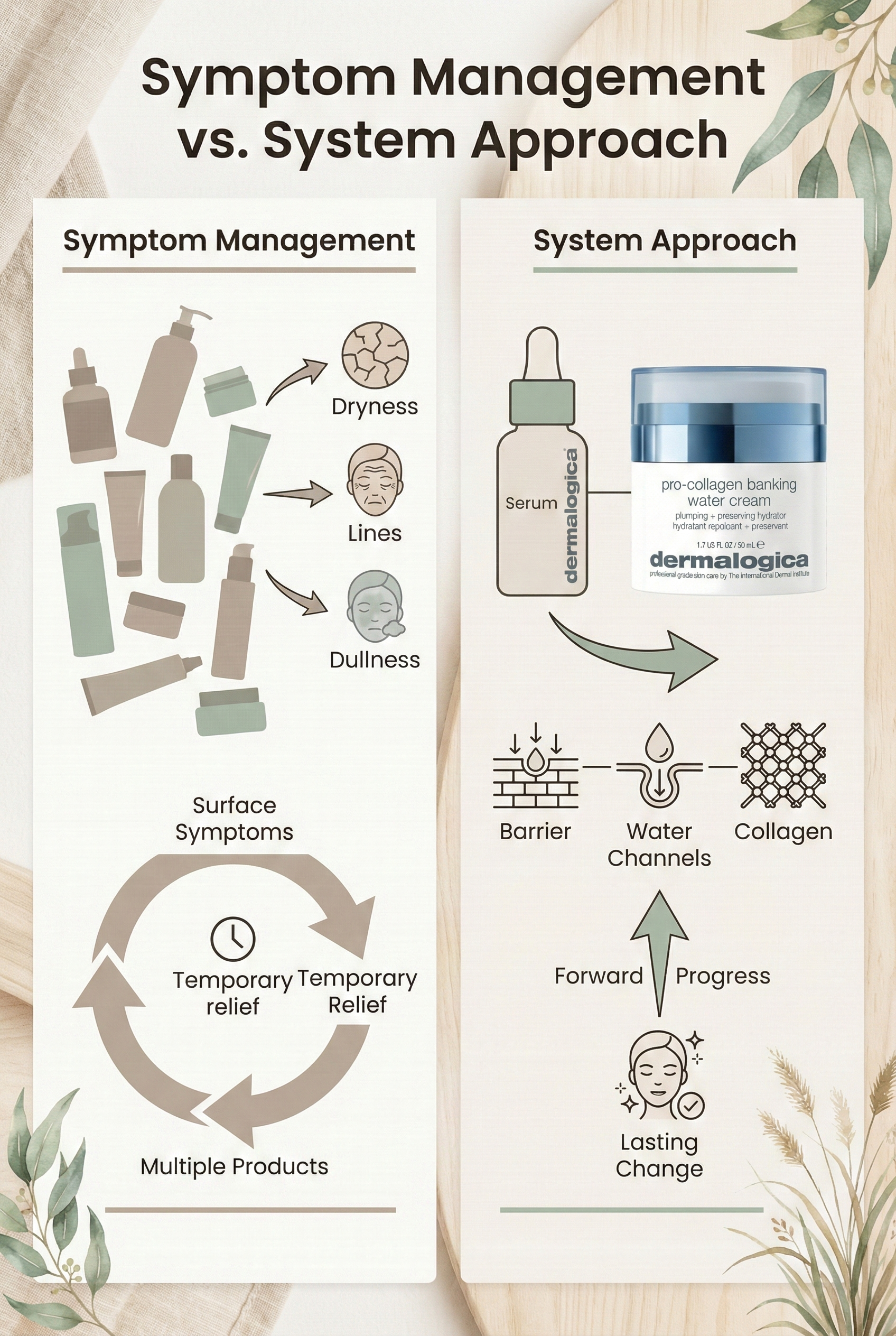
You see a fine line, you buy an anti-ageing serum. Your skin feels dry, you add a hydrating product. You notice dullness, you include an exfoliant. Each product targets a specific concern, but none of them address why these problems keep coming back. You're constantly putting out fires instead of preventing them from starting.
Here's the reality: most serums, no matter how advanced, address one problem. A vitamin C serum targets oxidative stress and pigmentation. A hyaluronic acid serum adds hydration. A retinol serum boosts collagen production. All valuable, all effective for their specific purpose. But if your barrier is compromised, that vitamin C might irritate before it brightens. If your water channels aren't functioning, that hyaluronic acid is just sitting on the surface. If swelling is high, that retinol might be breaking down collagen as fast as it's building it.
Then there's the moisturiser problem. Most moisturisers focus on surface hydration, they add water or humectants and seal it in with occlusives. This addresses the immediate feeling of dryness, but it doesn't fix water channel dysfunction or support deeper barrier repair. It's temporary relief, not lasting change. You feel better for a few hours, then you're back where you started.
But here's what I see skipped most often: the SEAL step. After cleansing, treating, and moisturising, your skin needs something that actually locks everything in and supports barrier integrity while you sleep. Not just an occlusive layer, but something that actively works on barrier repair, water retention, and collagen protection at once. Most people either skip this entirely or use a product that only does one of these things.
There's also a basic misunderstanding about prevention versus correction. Most anti-ageing products focus on correcting damage that's already happened, boosting collagen production, fading pigmentation, smoothing lines. And yes, that's valuable. But if you're not at once preventing new damage, you're running on a treadmill. You need to stop the withdrawals from your collagen bank while you're making deposits, or you'll never get ahead.
This is where a system approach differs from a product approach. Instead of asking 'What does this serum do?', you ask 'How do these products work together to address all three processes at once?' It's the difference between treating symptoms and treating causes.
Key Takeaways
- Three simultaneous processes are ageing your skin: barrier damage (causing moisture loss and reactivity), water channel dysfunction (slowing cellular hydration), and collagen breakdown (from enzymes, glycation, and oxidative stress).
- Most routines address only surface symptoms or single issues, missing the interconnected nature of these processes.
- Effective anti-ageing requires a system approach that prevents collagen loss while supporting barrier integrity and deep hydration, not just topica...
The Solution Exists (And It's More Straightforward Than You Think)
Here's the good news: you don't need to overhaul your entire routine or add ten more steps. You need two things working in tandem, one that stops the damage, one that repairs and protects.
The Pro-Collagen Banking approach addresses this exact problem. Think of it as a two-part system: prevent withdrawals from your collagen bank while making strategic deposits. The serum's role is stopping the breakdown, it targets those collagen-destroying enzymes, protects against glycation, and neutralises oxidative stress. It's your prevention step, your 'stop the damage' layer.
Then the Water Cream comes in as your protection and repair step. This is where barrier support, water channel function, and collagen protection happen at once. It's not just sealing in moisture, it's actively working on all three systems while you sleep. Supporting lipid barrier repair, optimising water movement through aquaporins, and creating an environment where collagen can rebuild without constant assault.
Why both matter: the serum without the cream means you're preventing damage but not supporting repair. The cream without the serum means you're repairing but not stopping the processes that caused the damage in the first place. Together, they address the cascade effect we talked about earlier, breaking the cycle where each problem feeds the others.
This isn't about adding complexity. It's about adding strategy. Two products working as a system will outperform five products working independently, because they're addressing root causes rather than surface symptoms.
If you're thinking 'But I'm already using good products', I hear you. And you likely are. The question is whether they're working together to address all three processes, or whether you're still just managing symptoms. Understanding what's actually happening inside your skin changes how you evaluate your routine. It shifts the focus from 'Does this feel nice?' to 'Is this actually preventing and repairing the basic processes of ageing?'
Ready to understand how this works for your specific skin? The Pro-Collagen Banking System might be exactly what your routine has been missing, not because your current products are wrong, but because the approach has been incomplete.
Understanding what's actually happening inside your skin, barrier damage, water channel dysfunction, and collagen breakdown happening at once, changes everything about how you approach skincare. It's not about adding more products or following the latest trend. It's about addressing root causes with a strategic system that prevents damage while supporting repair.
Your routine doesn't need to be complicated. It needs to be complete. And that means thinking beyond surface symptoms to the three basic processes that determine how your skin ages. When you address all three together, you stop running on that treadmill and start actually moving forward.


