


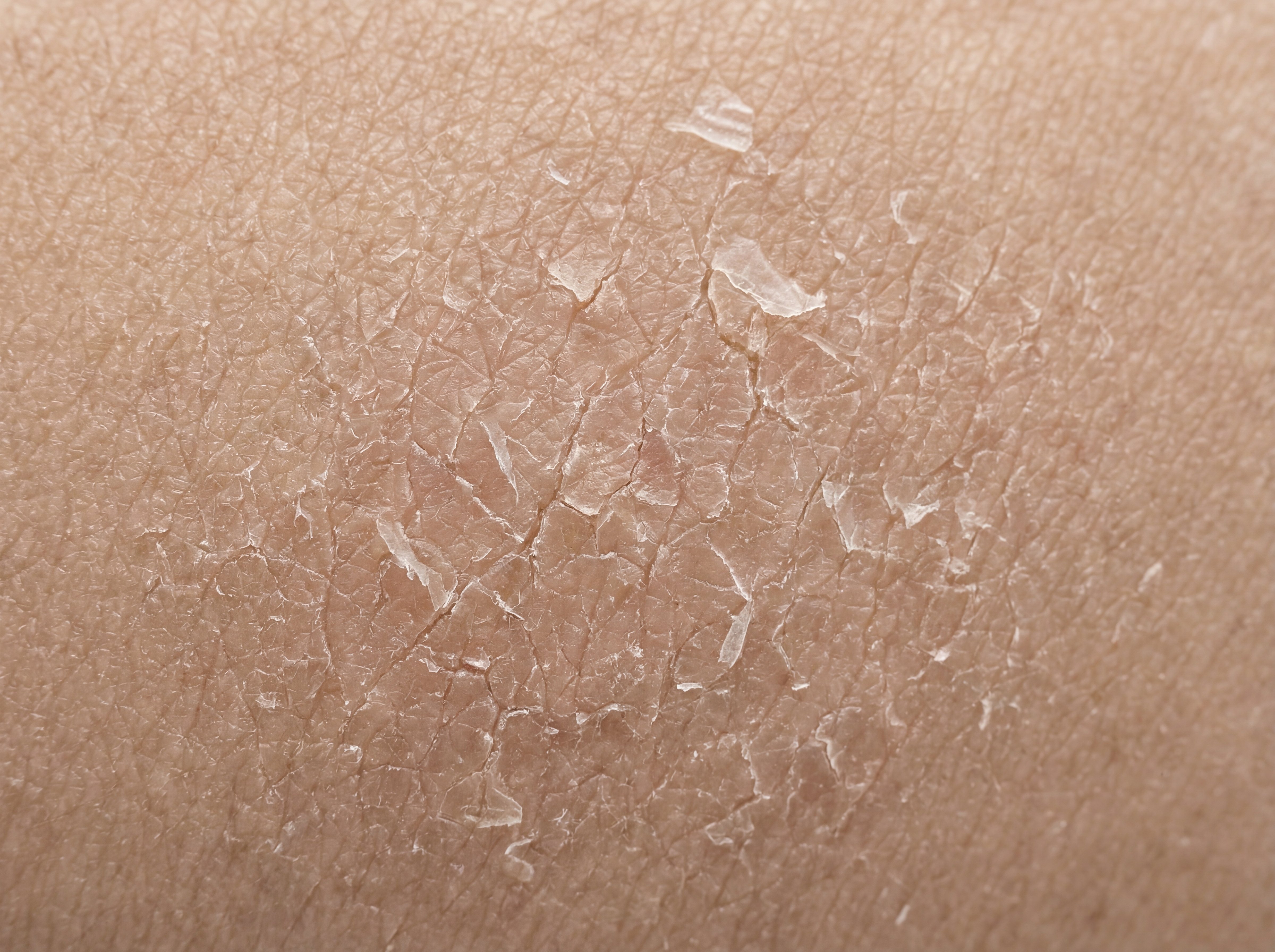
You moisturise twice daily. You've upgraded to richer creams. Maybe you've even started layering multiple hydrating products. And yet your skin still feels tight by midday, flaky patches appear without warning, and that uncomfortable dryness never quite goes away.
Here's what's actually happening: your moisturiser is doing its job, it's just not the job your skin needs right now. Surface hydration is important, but if your skin barrier is compromised, you're really pouring water into a leaky bucket. No amount of moisturiser will fix that. What your skin actually needs is barrier repair, and that requires a different approach entirely.
What a Healthy Barrier Actually Does (And Why It Matters More Than Hydration)
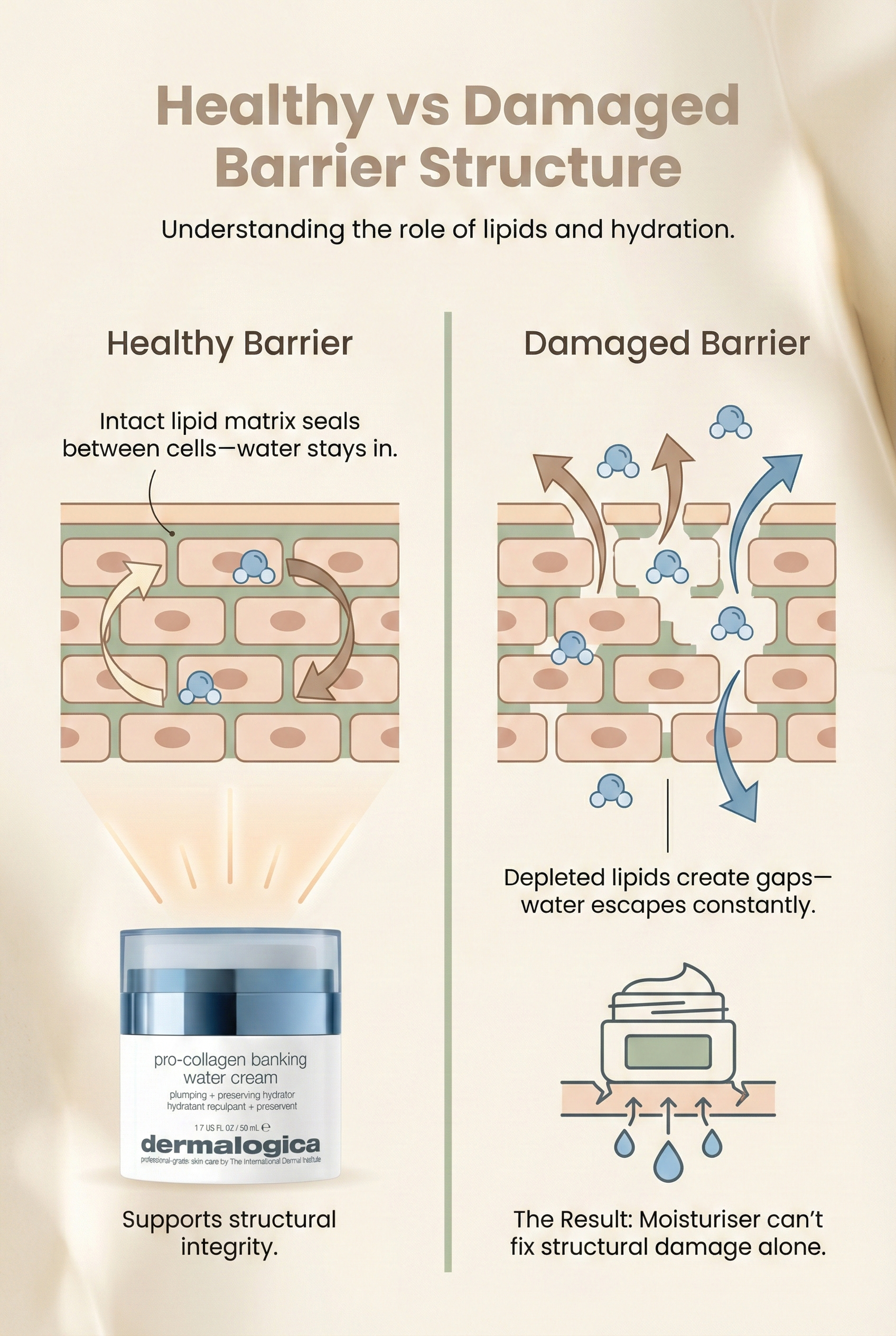
Your skin barrier isn't just a nice-to-have, it's the foundation of healthy skin function. Think of it as a brick wall: your skin cells are the bricks, and the lipid matrix between them is the mortar. When that mortar is intact, your barrier does three essential things.
First, it prevents water loss. Your skin naturally loses moisture throughout the day through a process called transepidermal water loss (TEWL). A healthy barrier keeps this loss minimal, around 10-15 grams per square metre per hour. When your barrier is damaged, that rate can double or triple, which is why your skin feels dry no matter how much you moisturise.
Second, it keeps irritants out. Environmental pollutants, bacteria, allergens, your barrier acts as a selective filter, allowing helpful substances in while keeping potential irritants at bay. When this function breaks down, your skin becomes reactive and sensitive to products that never bothered you before.
Third, it regulates swelling. A compromised barrier triggers causing swelling responses as your skin tries to repair itself. This swelling further damages the barrier, creating a cycle that's hard to break with moisturiser alone.
The lipid matrix that makes all this possible is composed of three key components: ceramides (about 50% of the barrier), cholesterol (25%), and free fatty acids (15%). When these are depleted, your barrier can't function properly, no matter how much water you're trying to put on top of it.
Here's the misconception that keeps people stuck: many assume dry skin simply needs more moisture. But if your barrier is damaged, adding moisture without repairing the barrier structure is like trying to fill a bucket with holes in it. The water goes in, but it doesn't stay.
Key Takeaways
- Your moisturiser provides surface hydration but can't repair a compromised skin barrier.
- Dry, tight skin often signals barrier damage, where the protective lipid layer between skin cells is weakened.
- Without barrier-repairing ingredients like ceramides and essential fatty acids, moisture escapes faster than you can replace it.
- Effective barrier repair requires two steps: barrier-rebuilding serums that replenish structural lipids, followed by occlusives that seal everything in.
- Most moisturise...
How Barriers Get Damaged (The Surprising Ways You're Weakening Yours)
Barrier damage rarely happens overnight. It's usually the cumulative effect of habits that seem harmless, or even helpful, in isolation. Understanding how your barrier got compromised is the first step to rebuilding it.
Over-exfoliation is the most common culprit. Chemical exfoliants like AHAs and BHAs, physical scrubs, even certain cleansing brushes, they all remove dead skin cells, which sounds like a good thing. But they also strip away the lipid layer if used too often or too aggressively. What starts as glowing skin after exfoliation becomes chronic dryness within weeks as your barrier struggles to keep up with the constant removal of protective lipids.
Harsh cleansers create immediate damage. Foaming cleansers with high pH levels (above 5.5) or strong surfactants disrupt your skin's natural acid mantle and strip barrier lipids. You'll notice this as that tight, squeaky-clean feeling after washing, which isn't actually a sign of clean skin, but rather a sign of a compromised barrier. Even one wash with the wrong cleanser can for now weaken your barrier; daily use compounds the damage.
Environmental stress accelerates breakdown. Cold, dry air in winter, hot water in showers, indoor heating, air conditioning, all of these pull moisture from your skin and stress the barrier. UV exposure generates free radicals that damage lipid structures. Even pollution particles can reach a weakened barrier and trigger causing swelling responses that further degrade barrier function.
Sensitivity and swelling create a vicious cycle. When your barrier is compromised, irritants reach more easily, triggering swelling. That swelling produces enzymes that break down ceramides and other barrier lipids. This weakens the barrier further, allowing more irritants in, causing more swelling. Without intervention that just rebuilds the barrier, this cycle perpetuates itself.
The tricky part? You might not connect these causes with your dry skin because the damage builds up gradually. You don't wake up one day with a destroyed barrier, it erodes slowly until you realise your moisturiser isn't working anymore and nothing feels quite right.

Why Your Moisturiser Alone Can't Fix It (The Science of Surface vs Structure)
Let's be clear: moisturisers aren't the problem. They're just designed for a different job than the one your compromised barrier needs. Understanding the distinction between surface hydration and barrier repair explains why you can moisturise religiously and still struggle with dry, uncomfortable skin.
Moisturisers provide surface hydration through humectants and occlusives. Humectants like hyaluronic acid and glycerin draw water into the outer layers of your skin. Occlusives like shea butter and dimethicone sit on top to slow water evaporation. This works beautifully when your barrier is intact, the occlusive layer reinforces your natural barrier, and the humectants boost hydration levels.
But when your barrier is damaged, you're dealing with structural deficiency, not just water deficiency. The lipid matrix between your skin cells is depleted. The mortar in your brick wall has crumbled. An occlusive moisturiser can slow down water loss for now, but it can't rebuild the missing ceramides, cholesterol, and fatty acids your barrier needs to function.
Here's the bucket analogy that makes this clear: imagine your skin barrier is a bucket with holes in it. A standard moisturiser is like pouring water into that bucket and putting a lid on top. The lid (occlusive layer) slows evaporation from the top, but water is still leaking out through the holes in the sides. You can keep pouring more water in, but you'll never fill the bucket until you patch the holes.
Barrier repair patches those holes. Barrier-repairing formulas contain the specific lipids your skin needs to rebuild the matrix between cells, ceramides that match your skin's natural ceramide profile, cholesterol in the right ratios, essential fatty acids that support lipid synthesis. These ingredients integrate into your barrier structure, literally filling in the gaps in your lipid matrix.
This is why you can feel dry even an hour after applying moisturiser when your barrier is compromised. The TEWL rate through your damaged barrier is so high that surface hydration can't keep pace. Studies show that damaged barriers can lose water at 2-3 times the normal rate, you'd need to reapply moisturiser every couple of hours just to maintain hydration, and even then, you're not addressing the underlying structural problem.
The timeline matters too. Surface hydration works within minutes, you feel the immediate relief of moisture. Barrier repair takes weeks because you're rebuilding cellular structures, not just coating the surface. This is why people often give up on barrier repair products too soon; they're expecting the instant gratification of moisturiser when they need to commit to the slower process of structural rebuilding.
The Two-Part Barrier Solution (How to Actually Rebuild What's Broken)
Effective barrier repair isn't about adding more products to your routine, it's about using the right products in the right sequence. The approach that consistently delivers results involves two distinct steps: barrier rebuilding followed by barrier sealing.
Step one: Rebuild with barrier-repairing serums. These lightweight formulas deliver concentrated barrier lipids, ceramides, cholesterol, essential fatty acids, in ratios that mirror your skin's natural composition. Unlike moisturisers that sit primarily on the surface, serums are designed to reach into the upper layers of your epidermis where barrier repair actually happens. They provide the raw materials your skin needs to synthesise new lipid structures and fill in the gaps in your compromised barrier.
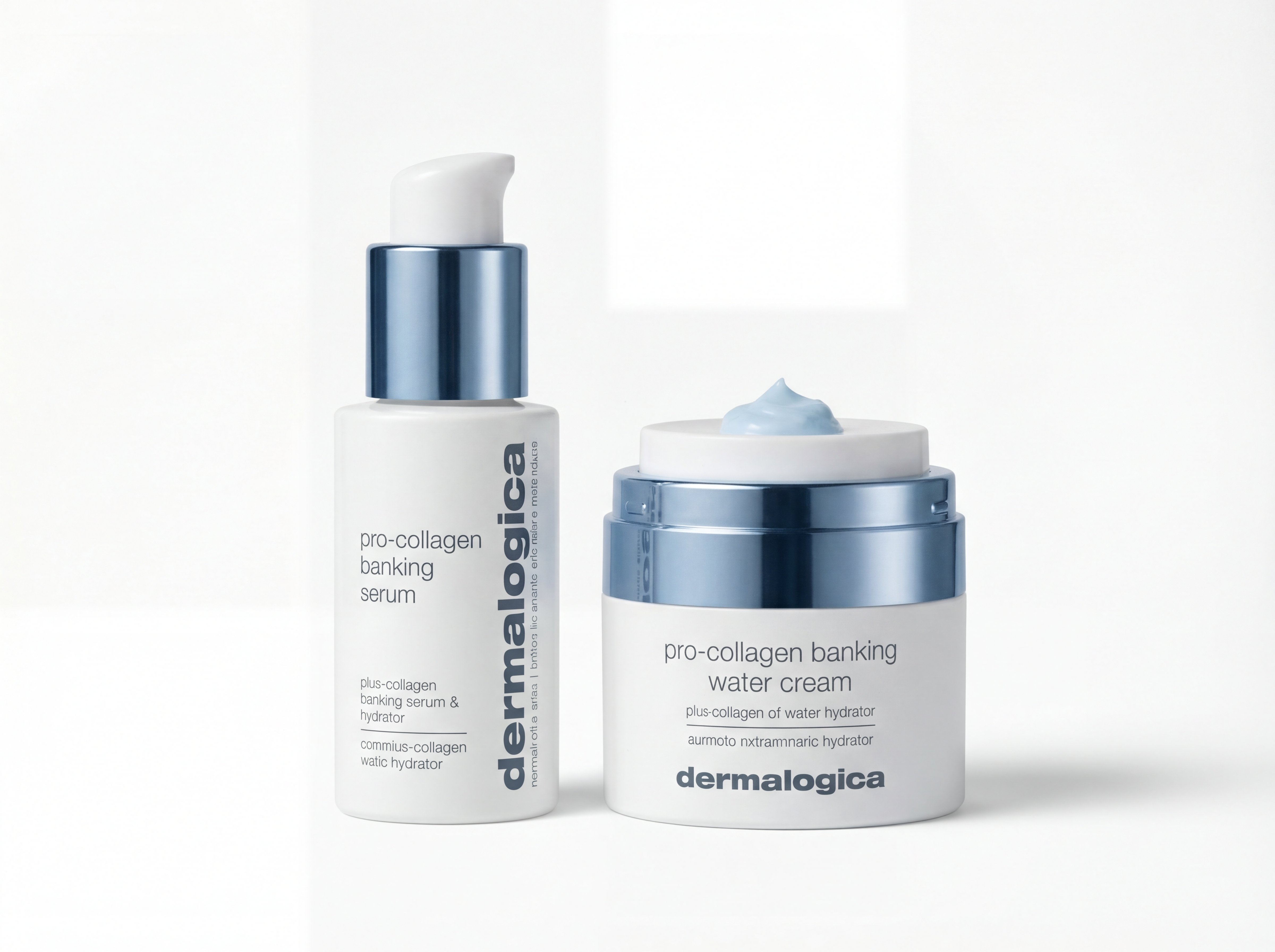
The Dermalogica Pro-Collagen Banking Serum is formulated just for this rebuilding phase. It delivers barrier-essential lipids along with collagen-supporting peptides that address both immediate barrier damage and long-term structural integrity. Apply it to damp skin after cleansing, the water helps carry these lipids deeper into your skin where they can integrate into the barrier matrix.
Step two: Seal with barrier-reinforcing moisturiser. Once you've delivered barrier-building ingredients, you need an occlusive layer that both slows water loss and provides additional barrier support. This is where the Pro-Collagen Banking Water Cream comes in, it's not just a moisturiser, it's the SEAL step that locks in the barrier repair work you've just done while helping its own barrier-strengthening ingredients.
Think of it as a two-part epoxy: the serum is part A (the resin that fills and bonds), the cream is part B (the hardener that sets and protects). Each does something the other can't, and together they create a result that neither could achieve alone.
Why both together work when either alone doesn't: The serum delivers concentrated barrier lipids without the occlusive layer that would prevent reach. The cream provides that occlusive protection plus additional hydration and barrier support. The serum rebuilds structure; the cream protects that structure while it integrates. One addresses the holes in the bucket, the other reduces evaporation from the top.
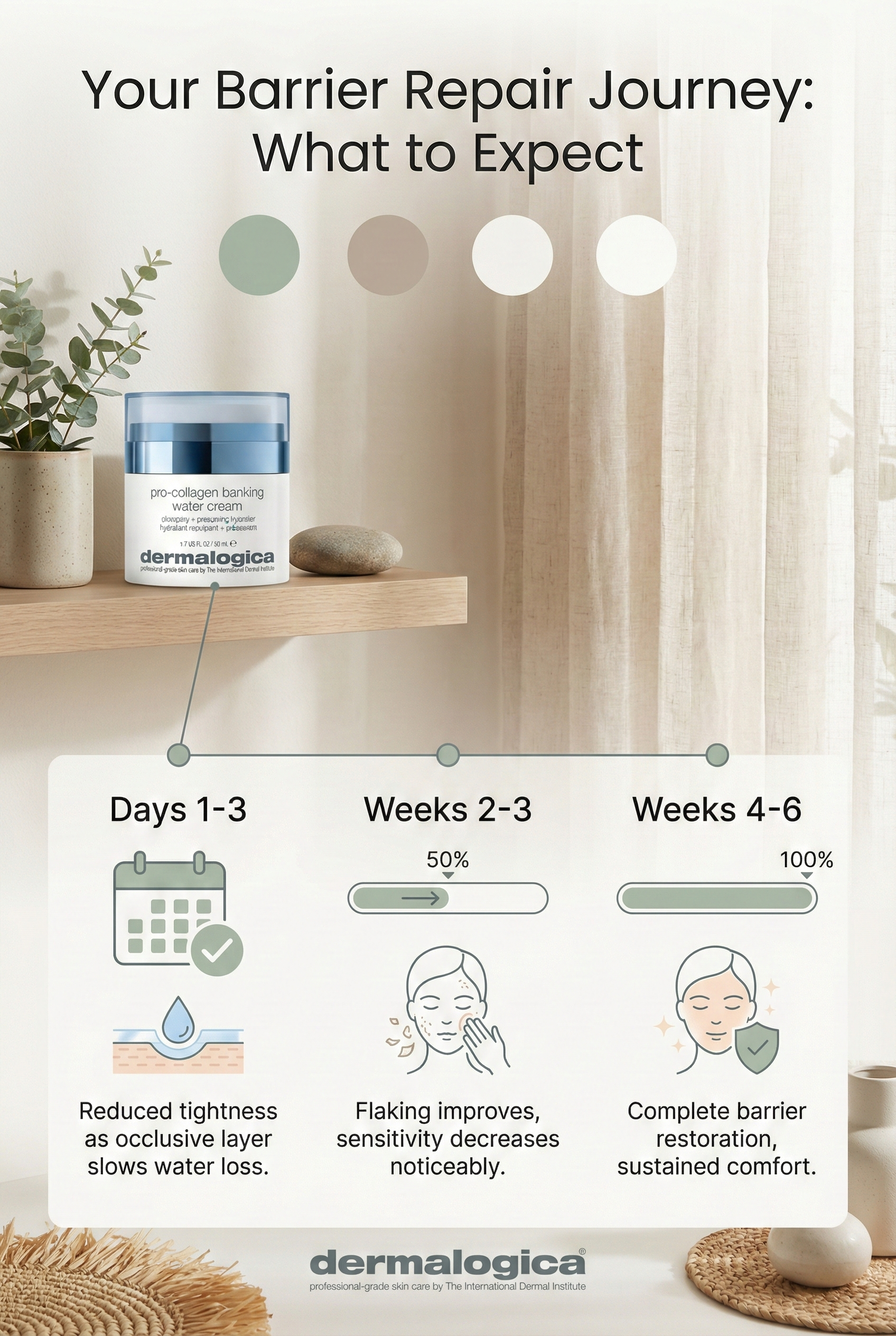
Timeline for barrier repair: You'll notice reduced tightness within days as the occlusive layer right away slows water loss. But true barrier rebuilding takes 4-6 weeks, the time it takes for new skin cells to migrate from the basal layer to the surface, carrying with them the improved lipid matrix you're now supporting. Flaking and sensitivity typically improve within 2-3 weeks as swelling decreases and barrier function begins to normalise. The key is consistency. Barrier repair requires sustained support, you're rebuilding cellular structures, not just applying a quick fix. Use both steps twice daily, and resist the temptation to add back harsh cleansers or aggressive exfoliants too soon. Give your barrier the time and support it needs to rebuild properly.
Your moisturiser isn't failing you, it's just not equipped to rebuild a compromised barrier on its own. Surface hydration matters, but when your skin barrier is damaged, you need targeted barrier repair that addresses the structural deficiency, not just the symptoms.
The two-part approach, barrier-rebuilding serum followed by barrier-sealing moisturiser, gives your skin both the raw materials to repair itself and the protection to maintain those repairs. It takes patience, but rebuilding your barrier properly means your moisturiser can finally do its job well because your skin can actually hold onto the hydration you're giving it.


