


Here's the uncomfortable truth about collagen: right now, your skin is losing it faster than it's making it. Not because you're doing something wrong, but because three different biological processes are actively destroying your collagen stores, and most anti-ageing routines only address one of them, if any.
Think of it like trying to fill a bucket with holes in it. You can pour water in all day (stimulate new collagen), but if you're not patching the holes (stopping the breakdown), you're fighting a losing battle. This is why so many people hit a plateau with their anti-ageing routine, they're working hard, but the maths just doesn't add up.
Let's talk about what's actually happening inside your skin, and why understanding these three collagen thieves changes everything about how you approach ageing.

What Collagen Actually Does (And Why Its Loss Changes Everything)
Collagen is the structural protein that keeps your skin firm, plump, and resilient. Think of it as the scaffolding that holds everything up, when it's strong and abundant, your skin bounces back from expressions, maintains its shape, and looks full. When it worsens, you get sagging, lines that don't fade, and that general deflated look that no amount of surface hydration can fix.
Here's the timeline that matters: starting around age 30, you lose about 1% of your collagen per year. That doesn't sound dramatic until you do the maths, by 50, you've lost about 20% of your collagen stores. By 60, it's closer to 30%. This gradual decline is why ageing doesn't happen overnight but rather creeps up in ways that feel sudden when you finally notice them.
But here's what most people don't realise: that 1% annual loss isn't just natural ageing, it's accelerated by lifestyle factors you can actually control. Sun exposure, sugar intake, stress, pollution, smoking, all of these speed up the three collagen-destroying processes we're about to discuss.
The biggest misconception about collagen? That you can simply replace what you've lost by using products with collagen in them or taking collagen supplements. While stimulating new collagen production is important, it's only part of the equation. If you're not at once stopping the accelerated breakdown, you're just slowing the decline, not reversing it.
This is why collagen deserves your attention above almost any other anti-ageing concern. Address collagen properly, both the breakdown and the building, and you address the basic structure of ageing skin.
Key Takeaways
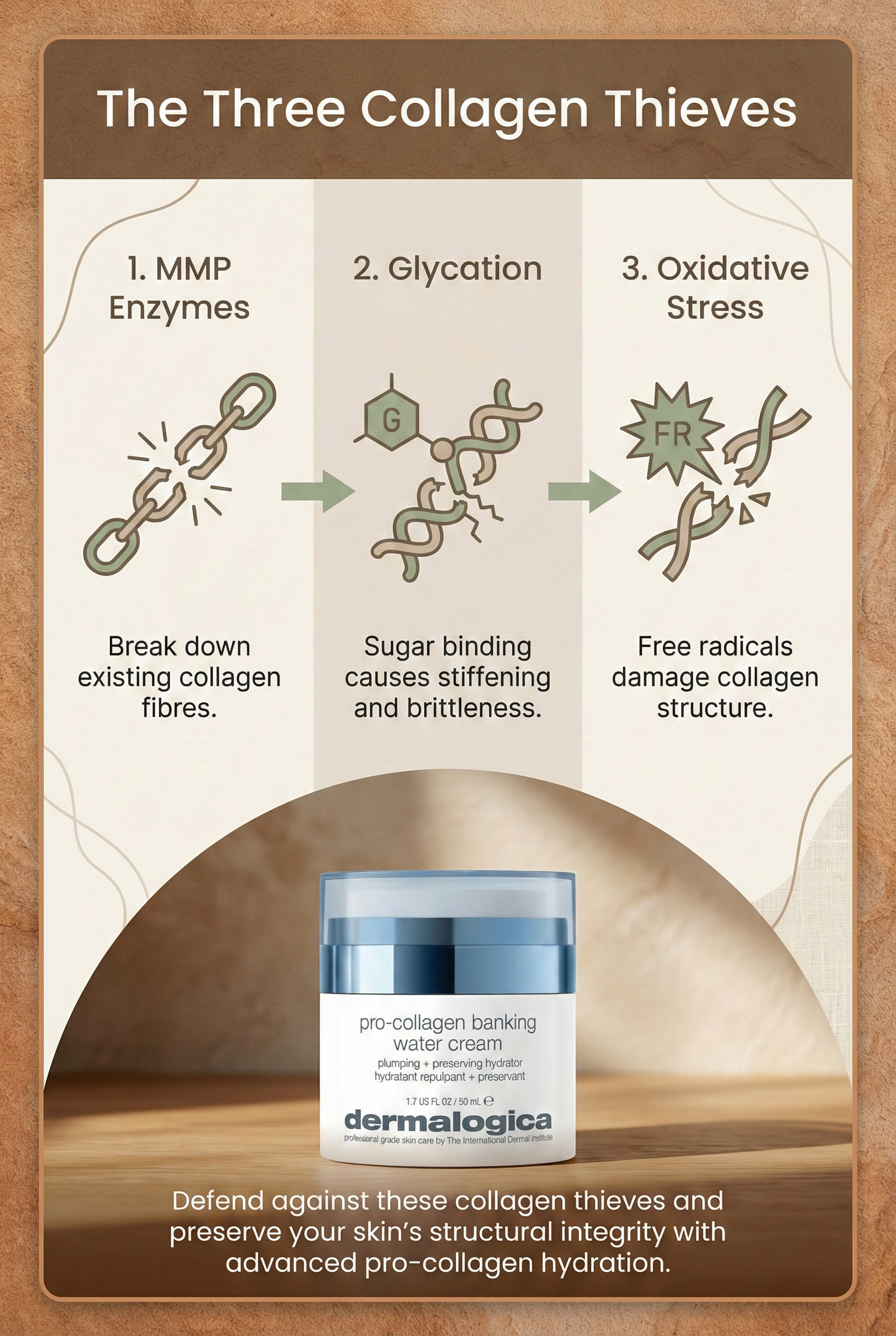
- Your skin loses collagen through three simultaneous processes: MMP enzymes break down existing collagen, glycation stiffens collagen fibres through sugar binding, and oxidative stress damages collagen structure.
- Most anti-ageing products only address one pathway, usually stimulating new collagen production, while ignoring the accelerated breakdown.
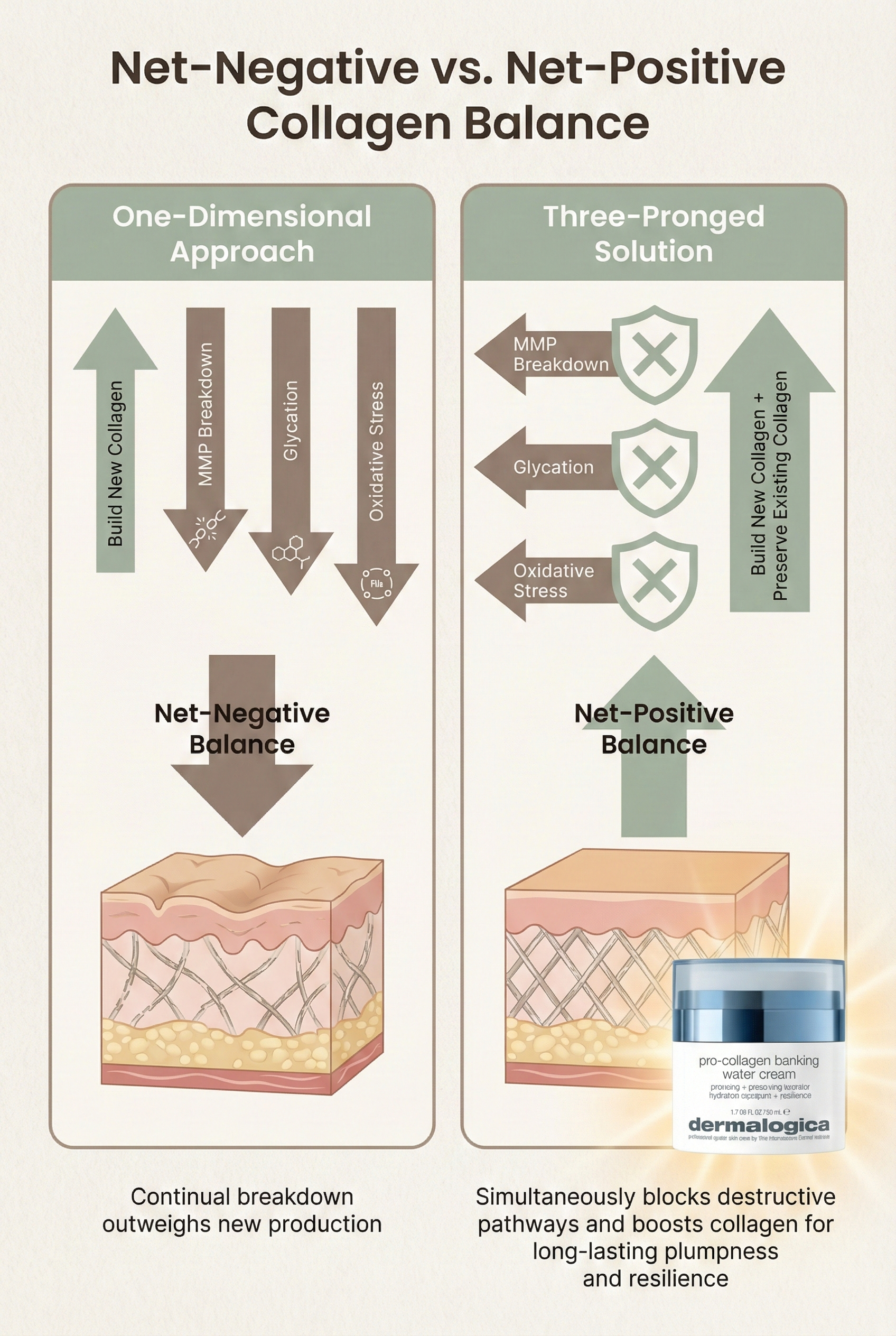
- This creates a net-negative collagen balance, which is why many people plateau despite using 'good' products.
- Effective collagen banking requires...

The Three Collagen Thieves Working Against You Right Now
Three distinct biological processes are actively destroying your collagen, and they work independently of each other. This means even if you're addressing one, the other two are still doing damage. Let's break them down.
Thief One: Matrix Metalloproteinase (MMP) Enzymes
MMPs are enzymes your body produces that literally break down collagen fibres. In healthy skin, they're part of normal tissue remodelling, breaking down old collagen so new collagen can take its place. The problem is that certain triggers cause your body to overproduce these enzymes, leading to excessive collagen breakdown.
The biggest MMP trigger? UV exposure. Even incidental sun exposure, walking to your car, sitting near a window, activates MMP production that continues breaking down collagen for days after the exposure. swelling, pollution, and stress also ramp up MMP activity. This is the thief that most anti-ageing products completely ignore, focusing instead on building new collagen while MMPs quietly dismantle it.
Thief Two: Glycation
This is the process nobody talks about, and it's possibly the most insidious. Glycation occurs when sugar molecules in your bloodstream bind to collagen fibres, creating what are called Advanced Glycation End Products (AGEs, yes, the acronym is unfortunate but accurate).
When sugar attaches to collagen, it causes the fibres to cross-link and stiffen. Instead of flexible, springy collagen that allows your skin to move and bounce back, you get rigid, brittle collagen that cracks under pressure. This is why glycated skin often shows deep expression lines, the collagen literally can't flex anymore.
The acceleration factor here is dietary sugar and high-glycaemic foods, but also chronic swelling and oxidative stress. Once collagen is glycated, it can't be un-glycated, the damage is permanent. This is why prevention is critical, and why this process deserves as much attention as sun protection.
Thief Three: Oxidative Stress
Free radicals, unstable molecules generated by UV exposure, pollution, stress, and normal metabolism, attack collagen structure directly. They damage the amino acids that make up collagen fibres, causing them to fragment and lose their structural integrity.
Think of it like rust on metal scaffolding. The structure is still there, but it's compromised, weakened, and can't perform its supporting function properly. Oxidative stress also triggers swelling, which circles back to increased MMP production, so this thief actually amplifies the damage from Thief One.
The compound effect is what matters most. These three processes don't just add up, they multiply each other's impact. Oxidative stress triggers MMPs. Glycation makes collagen more at risk to MMP breakdown. MMP activity creates swelling that accelerates glycation. It's a destructive cycle that explains why skin ageing can feel like it suddenly accelerates after a certain point.
Why One-Dimensional Anti-Ageing Keeps You Stuck on a Plateau
Most anti-ageing products focus exclusively on stimulating new collagen production. Retinoids, peptides, vitamin C, they all work to signal your skin to make more collagen. And they work. The problem is, they're only addressing half the equation.
If you're stimulating new collagen production but doing nothing to stop the accelerated breakdown from MMPs, glycation, and oxidative stress, you're in a constant race against destruction. You might see initial improvements as new collagen fills in some of the deficit, but in time you hit a plateau because you're still losing collagen faster than you're building it.
Some products focus on antioxidants to combat oxidative stress, which is helpful but incomplete. Antioxidants address one of the three thieves, leaving MMPs and glycation to continue their damage unchecked. Others include peptides that might offer some MMP inhibition, but without addressing glycation or providing complete protective protection.
This is why so many people come to me frustrated. They're using good products, sometimes expensive products, and they saw improvements at first, but now they've stalled. They're in a net-negative collagen account, where the daily losses exceed the daily gains, even with active intervention.
The solution isn't to add more products or use higher amounts. It's to address all three destructive pathways at once while supporting new collagen synthesis. This is what I call collagen banking, protecting what you have while strategically building reserves.
The Three-Pronged Solution: Protection, Prevention, and Production
Effective collagen banking requires a coordinated approach that addresses all three collagen thieves while supporting new collagen synthesis. This is where Dermalogica's Pro-Collagen Banking System becomes relevant, not because it's the only solution, but because it's just designed around this three-pronged strategy.
The serum's role is defensive: Pro-Collagen Banking Serum contains niacinamide and phytoactives that inhibit MMP activity, preventing excessive collagen breakdown. It includes anti-glycation ingredients that block sugar molecules from binding to collagen fibres. And it provides protective protection against free radical damage. This is the 'patch the holes in the bucket' step, stopping the accelerated loss.
The moisturiser's role is offensive: Pro-Collagen Banking Water Cream stimulates new collagen production through plant-based actives and peptides. But it does something equally important, it provides the hydration environment that collagen synthesis requires. Dehydrated skin can't build collagen efficiently, which is why moisture is basic, not optional, in anti-ageing.
Why both together matters: Using just the serum means you're preventing breakdown but not actively building. Using just the cream means you're building while destruction continues unchecked. Together, you shift the collagen balance from net-negative to net-positive. You're not just slowing ageing, you're actively banking collagen reserves.
The clinical evidence supports this: in studies, the combination showed visible improvement in firmness and reduction in line depth within 8-12 weeks. That timeline matters because it's realistic, collagen changes take time. Anyone promising dramatic results in days or weeks is selling you something that works on the surface, not at the structural level where collagen lives.
The reason so many anti-ageing routines plateau isn't because they're not working, it's because they're only addressing part of the problem. Stimulating new collagen while three destructive processes continue unchecked is like trying to save money while your bank account has automatic withdrawals you didn't know about.
Understanding these three collagen thieves, MMPs, glycation, and oxidative stress, changes how you think about anti-ageing. It's not about finding the one miracle ingredient or the most expensive serum. It's about addressing all the pathways at once, protecting what you have while strategically building reserves.
This is what collagen banking means: shifting from a net-negative to a net-positive collagen balance through coordinated protection, prevention, and production. The timeline requires patience, but the maths finally works in your favour.


