



If you've noticed your skin looking a little flat lately, not quite dull, not quite dry, just somehow less like itself, you're not imagining it. After your mid-thirties, your skin's ability to repair and renew itself slows down in measurable ways. Collagen production drops roughly 1% every year after age 20. Cell turnover stretches from 28 days to 45 or even 60 days.
The result? Skin that looks tired, feels uneven, and doesn't bounce back the way it used to. So when a new ingredient category called exosomes starts appearing in skincare, it's worth understanding what they actually are. And whether the science behind them is real.
This article explains what exosomes in skincare are, how plant-derived exosomes work in mature skin. And where the newest Dermalogica innovation, the Phyto Nature E2 Regenerating Daily Exosome Leave-on Treatment, fits into a real daily routine. No hype, no miracle claims. Just honest, clear information so you can decide whether this is something your skin actually needs right now.
What Are Exosomes and Why Does Skincare Use Them?
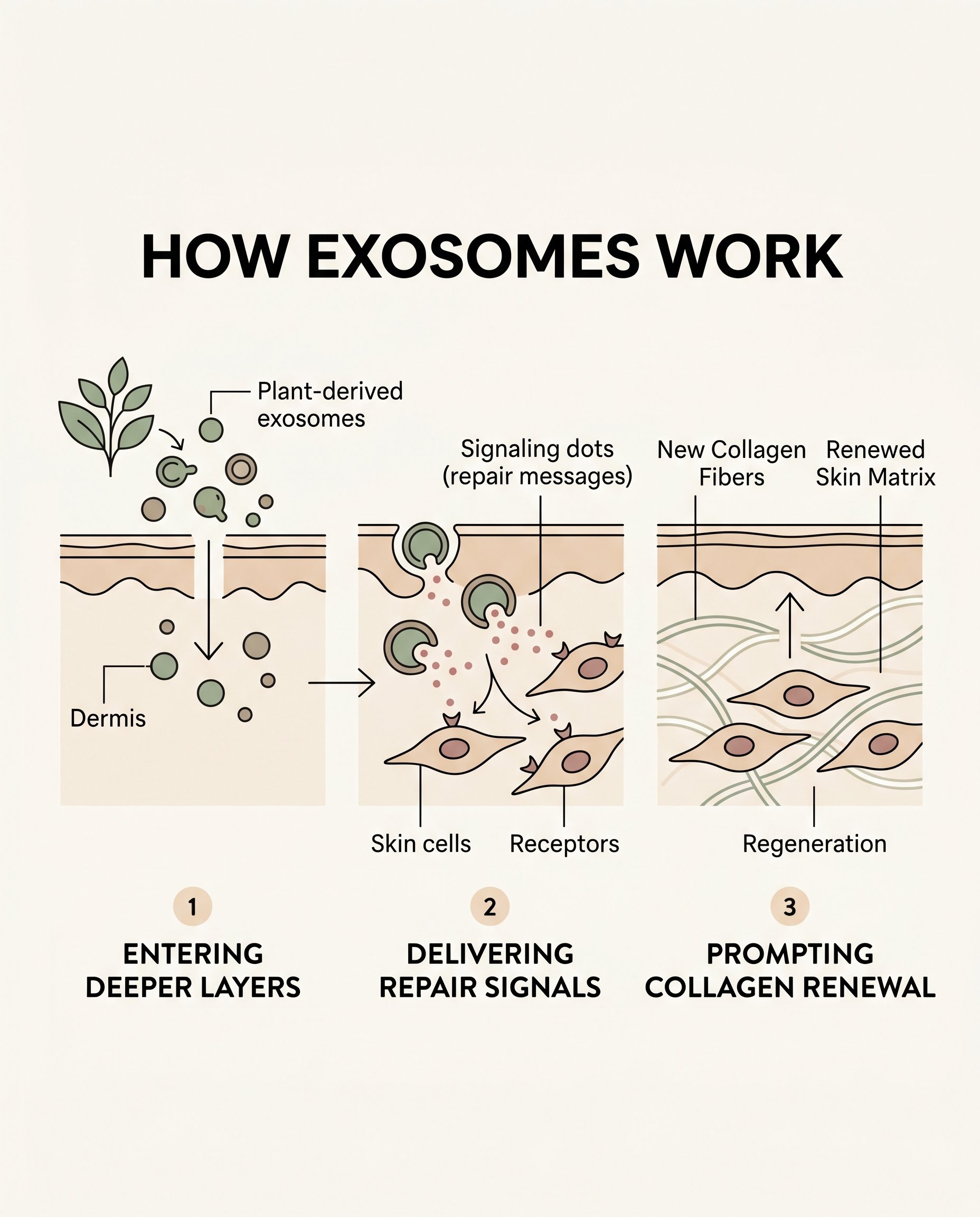
Exosomes are tiny messengers made by living cells. Think of them as sealed packages that carry instructions from one cell to another. They are nano-sized, meaning they are far smaller than a skin cell itself. Inside each exosome is a cargo of proteins, lipids. And genetic signals that tell the receiving cell what to do, repair, regenerate, calm down, produce collagen.
Your skin already uses this communication system naturally. The problem is that as you age, the cells sending those repair signals become less active. Fibroblasts (the cells responsible for making collagen and elastin) slow down significantly after menopause. They are still there, they just need a nudge. That is exactly where plant-derived exosomes come in.
In skincare, exosomes are sourced from plants rather than human or animal cells. Plant-derived exosomes carry similar bioactive signals. When applied to skin, they penetrate into the deeper layers and deliver those signals to your own cells. The result is skin that starts behaving more like it did a few years ago, not because something artificial has been added. But because your own cells have been prompted to do their job again.
How Are Plant-Derived Exosomes Different From Other Active Ingredients?
Most skincare actives work by delivering a specific substance to the skin. Vitamin C delivers an antioxidant. Hyaluronic acid delivers hydration.
Retinoids deliver a signal to speed up cell turnover. These are all valuable, and the evidence behind them is strong. But they work in a fairly direct, one-dimensional way, one ingredient, one action.
Exosomes work differently. Because they carry a complex cargo of signals, they communicate with your skin's own repair systems. The same treatment can support collagen renewal in one area, calm inflammation in another, and help restore hydration where the barrier is weak. The mechanism adapts to where your skin needs it most. This is why exosomes are generating genuine interest in skin science, not just marketing departments.
It is worth being clear about what the evidence shows so far. Plant-derived exosomes in topical skincare are a newer area of research. The clinical data that exists is promising.
Dermalogica's clinical data for the E2 treatment shows up to 86% improvement in natural skin regeneration and visible results in around two weeks, with up to 6 years of skin's biological age reversed in 8 weeks, though individual results vary. These figures are worth noting, but they are not a promise that every person will see the same outcome. What the science does support clearly is the mechanism: exosomes can penetrate effectively and deliver bioactive signals that support cellular repair.
Key Takeaways
- Exosomes are nano-sized messengers produced by cells.
- In skincare, plant-derived exosomes carry bioactive signals into the deeper layers of skin, telling cells how to repair and renew themselves.
- They support collagen production, calm inflammation, and help restore the skin's own regenerative capacity.
- This makes them especially relevant for mature and menopausal skin, where the fibroblasts (collagen-producing cells) have slowed down.
- Unlike traditional active ingredients that work on the sur...

Why Do Exosomes Matter for Menopausal and Mature Skin?
The changes that happen in skin during perimenopause and after menopause are real and measurable. Oestrogen decline accelerates collagen loss, research shows up to 30% of collagen can be lost in the first five years post-menopause. Fibroblast activity drops. Cell turnover slows.
The skin barrier weakens as ceramide production falls. The result is a combination of concerns that often appear at the same time: dullness, uneven texture, fine lines, loss of firmness, increased sensitivity. And dehydration that no amount of moisturiser seems to fix.
This is where exosomes are particularly relevant. Because they work by restoring the skin's own regenerative signals, they are well suited to skin where the repair system has slowed rather than stopped. They are not overriding your biology, they are supporting it. For women navigating menopausal skin changes, that distinction matters. Understanding how firming serums support collagen is a useful piece of this picture, and exosomes add a new layer to that conversation.
Post-retinol sensitivity is another concern exosomes speak to directly. Many women in their forties and fifties are using retinoids, rightly so, given the evidence behind them. But retinoids can cause a period of sensitivity and flaking, especially when you first start or if you increase frequency. An exosome treatment that also contains a gentle enzyme exfoliant, and that is not photosensitising, fits naturally into a retinoid routine as a rest-day option. More on that below.
What Is the Dermalogica Phyto Nature E2 Regenerating Daily Exosome Leave-on Treatment?
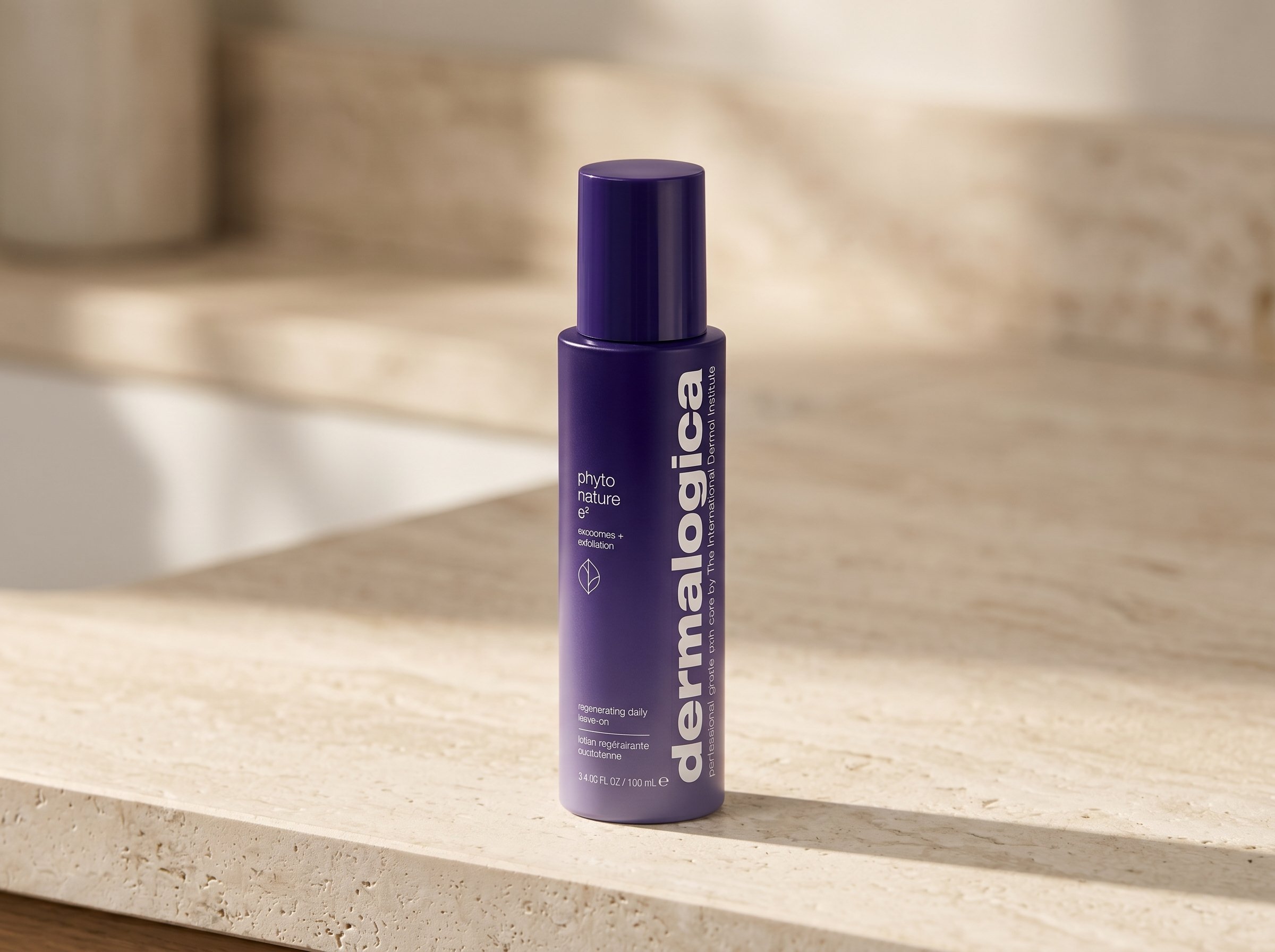
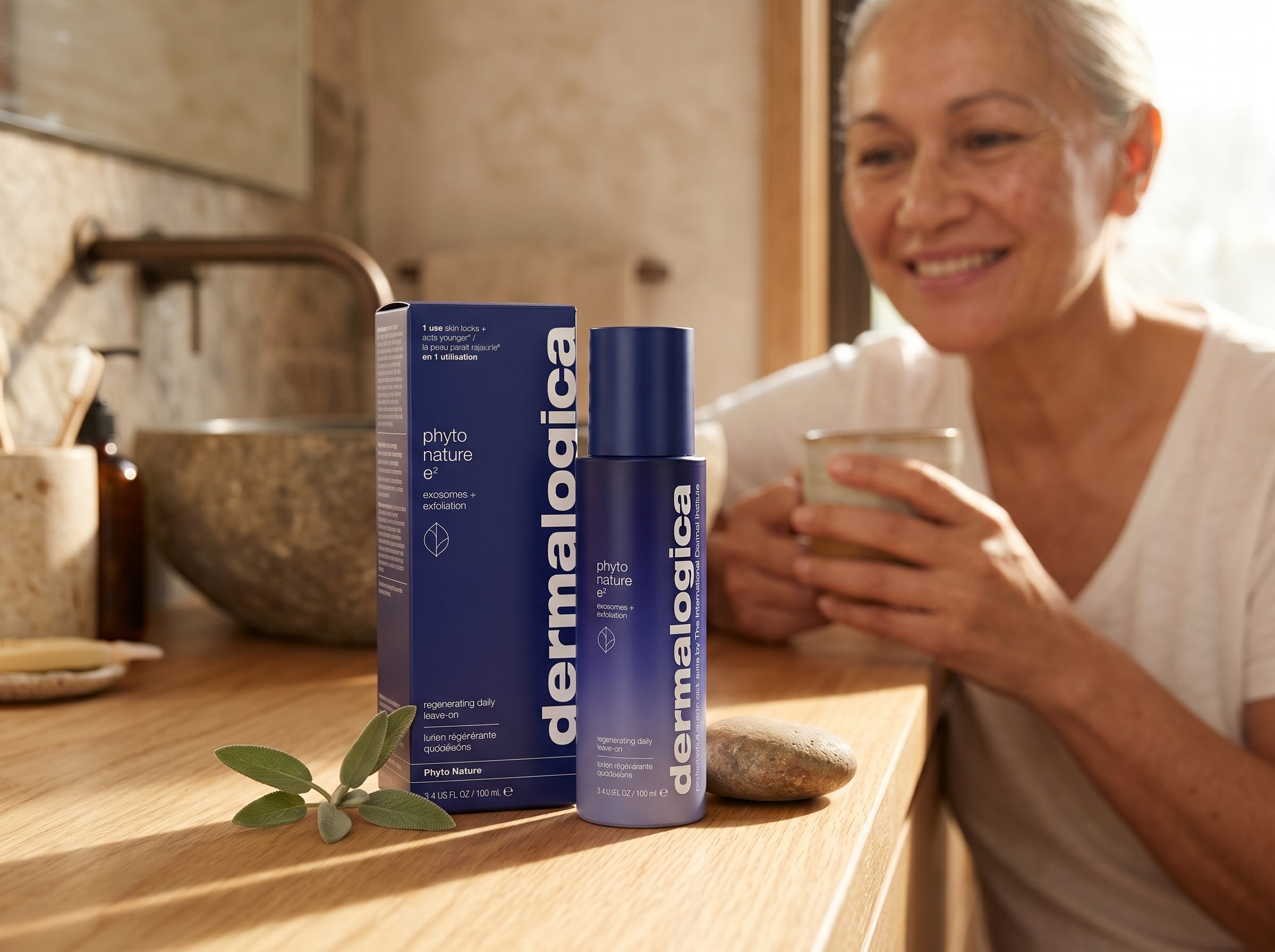
The Dermalogica Phyto Nature E2 Regenerating Daily Exosome Leave-on Treatment is the newest addition to the Phyto Nature family. This also includes the Phyto Nature Firming Serum, the Phyto Nature Oxygen Cream, and the Phyto Nature Lifting Eye Cream. The E2 joins a range already focused on supporting mature skin through plant-based, science-backed formulations.
The E2 combines two key mechanisms in a single daily step. The first is plant-derived exosomes, which deliver regenerative signals into the deeper layers of skin to support collagen renewal, calm inflammation. And restore the skin's capacity to repair itself.
The second is Pumpkin Enzyme (Cucurbita Pepo), which dissolves the bonds holding dead skin cells on the surface. This is a form of enzymatic exfoliation, it helps skin shed what it no longer needs without any scrubbing or acid-based exfoliants. Importantly, pumpkin enzyme is not photosensitising, which means it can be used in the morning or at night without increasing sun sensitivity.
This combination means the E2 resurfaces and regenerates in a single step. Dead cells are cleared so that the exosome signals can reach the skin more effectively. For skin that is dealing with dullness, uneven texture, fine lines, loss of firmness, post-retinol sensitivity, or menopausal changes, that dual action is genuinely useful. Clinically supported approaches to radiance and fine lines are worth reading alongside this, as they give helpful context for what to expect from active treatments over time.
Is the Pumpkin Enzyme Exfoliation Suitable for Sensitive Skin?
This is a fair question, and it matters. Enzymatic exfoliation works differently from acid exfoliants like glycolic or lactic acid. Enzymes break down the protein bonds between dead skin cells at the surface. They do not lower the skin's pH the way acids do. And they do not cause the same level of irritation in sensitive or reactive skin.
Pumpkin enzyme in particular is well suited to skin that cannot tolerate stronger exfoliants. This includes post-retinol skin on its rest days, rosacea-prone skin, menopausal skin that has become more reactive. And skin that has been sensitised by over-exfoliation in the past. Managing redness and sensitivity is a topic worth exploring if you are in this category, because understanding your skin's current state helps you choose the right level of exfoliation.
Because the pumpkin enzyme in the E2 is not photosensitising, you are not restricted to evening use. This gives you flexibility. Use it in the morning before SPF, or in the evening as part of your renewal routine.
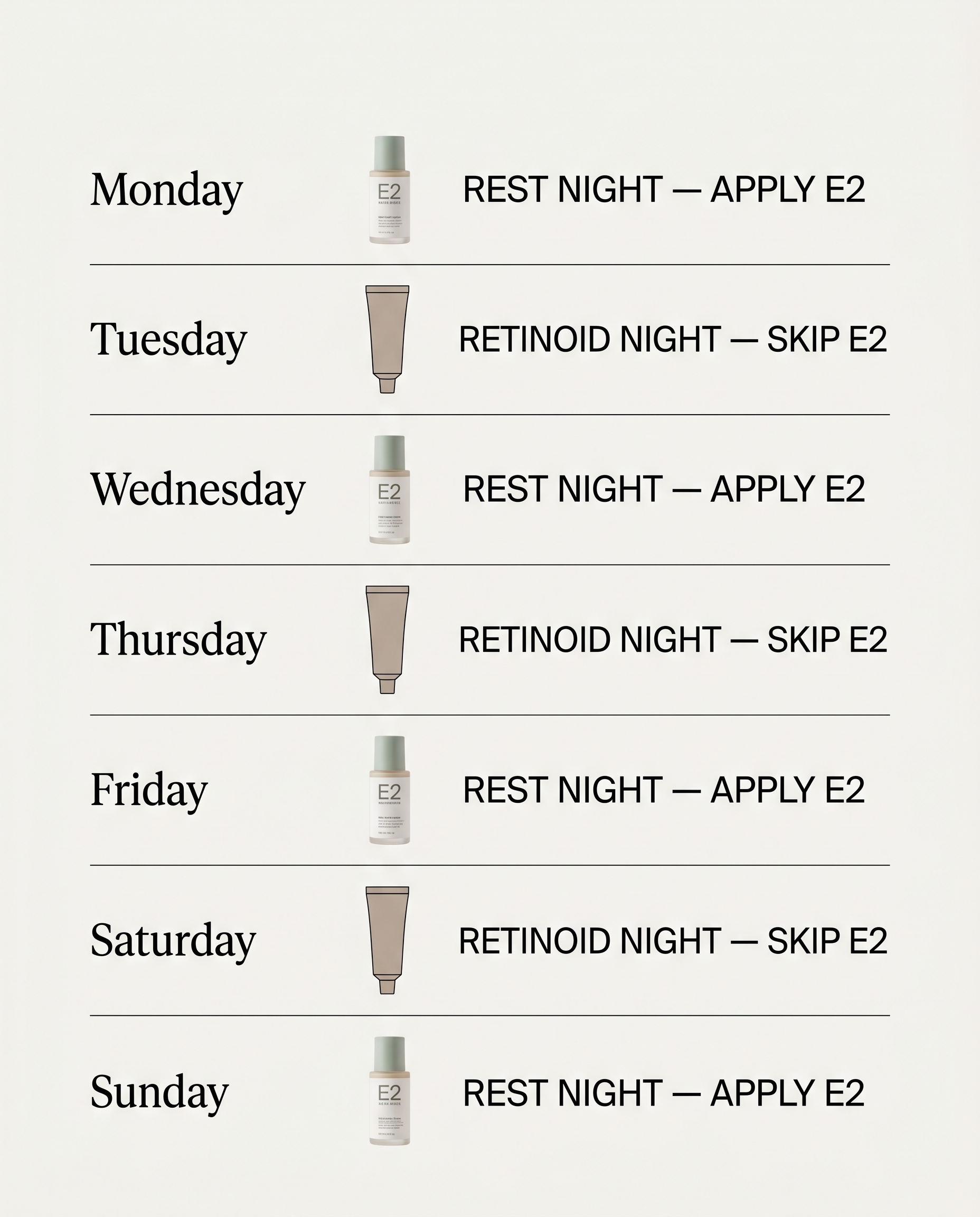
On nights when you use a retinoid, skip the E2. On the nights in between, the E2 sits comfortably as your exfoliation and regeneration step. It is a genuinely practical fit for a real routine.
How Does the E2 Fit Into a Daily Skincare Routine?
The E2 is designed as a leave-on treatment, not a rinse-off mask or a toner. You apply it after cleansing and before your moisturiser and SPF. It works as a single step that covers both exfoliation and regeneration, so it simplifies rather than complicates your routine. This matters, because one of the most common issues I see with mature skin routines is that they have grown complicated over time, lots of products, unclear order, no real plan.
The E2 pairs well with a hyaluronic acid serum layered on top for extra hydration, a peptide moisturiser to support collagen further, and SPF 50+ in the morning. Getting your product order right is one of the simplest ways to get more from what you already use. And the E2 slots in cleanly at the treatment step. If you are also using the Phyto Nature Firming Serum, the two can work together, the E2 clears the surface and delivers regenerative signals. Meanwhile, the Firming Serum supports structural support deeper in the skin.
For retinoid users, the rhythm looks like this: retinoid nights alternate with E2 nights. You are never doubling up on exfoliation, and you are giving your skin consistent renewal support across the week. This approach respects your skin's pace rather than pushing it harder than it needs to go. If you are new to retinoids or working through sensitivity, understanding how your skin responds to seasonal and routine changes can help you build confidence in the process.
What Results Can You Realistically Expect?
Dermalogica's clinical data attributes up to 86% improvement in natural skin regeneration and up to 6 years of skin's biological age reversed in 8 weeks to the E2 treatment, with visible results noted in around 2 weeks. These figures come from Dermalogica's own clinical testing, and individual results vary. It is worth being honest about what that means: your results will depend on your starting point, your consistency. And how your skin responds to the formulation.
What you can reasonably expect with consistent use is improved texture as dead cells clear more efficiently, a more even and less dull appearance as cell turnover is supported. And a gradual improvement in firmness and fine lines as the exosome signals prompt collagen renewal. These are not overnight changes. Skin biology works on a cycle of weeks, not days. The 2 week visible result claim aligns with the surface changes from enzymatic exfoliation, which tend to show up faster than deeper structural changes.
The honest framing is this: the E2 is a well-designed daily treatment that combines two evidence-supported mechanisms in a single step. It is suited to mature and menopausal skin dealing with multiple conce ns at once. It is not a replacement for SPF, a solid moisturiser, or the foundational habits that keep skin healthy over time. It is a meaningful addition to a routine that already has those foundations in place.
The Dermalogica Phyto Nature E2 Regenerating Daily Exosome Leave-on Treatment is a considered, practical addition to a mature skin routine. It combines plant-derived exosomes with gentle pumpkin enzyme exfoliation in a single daily step, works morning or evening. And sits comfortably alongside retinoids, hyaluronic acid serums, peptide moisturisers, and SPF. If you are not sure whether it fits your current routine, or if you are ready to take a proper look at what your skin actually needs right now, please reach out and we will have one of our Skin Therapists assist.


