


You've tried the serums. You've tried the creams. You drink your water, you follow the routines, and still, within minutes of washing your face, that tight, uncomfortable feeling is back. It's frustrating in a way that's hard to explain to someone who hasn't felt it.
Here's what I want you to know: this isn't a product problem. It's a barrier problem. And once you understand what's actually happening in your skin, the whole thing starts to make sense. Let's look at what's really going on, and what might actually help.

What Is Your Skin Barrier and Why Does It Matter?
Think of your skin barrier like a brick wall. Your skin cells are the bricks. The mortar holding everything together is made of three specific lipids: ceramides (natural fats that make up about 50% of the mortar), cholesterol (about 25%), and fatty acids (about 15%). When that mortar is intact, your skin holds moisture beautifully and feels comfortable all day.
When it's depleted, water escapes through the gaps. Dermatologists call this elevated TEWL, which stands for trans-epidermal water loss. In healthy skin, water loss sits at around 5 to 10 g/m² per hour.
In compromised skin, it can climb past 15 g/m² per hour. That's the tightness you feel. Your skin is losing water faster than anything you apply can replace it.
You can read more about how your barrier works here. But the key point is this: no amount of moisturiser will fix a depleted barrier if you're not giving your skin the actual building blocks it needs to rebuild.

Why Does the Barrier Get Compromised in the First Place?
This is the question I get asked most often, and the honest answer is: it's rarely one thing. Barrier compromise builds up over time from a combination of factors. Harsh cleansers, over-exfoliation, environmental stress, and natural ageing all chip away at those lipid layers.
Australian conditions add another layer of challenge. Our UV index reaches 11 or higher in summer, and research shows UV exposure can reduce ceramide content by up to 35% in sun-exposed skin. Winter brings low humidity and constant air conditioning, which pulls moisture from your skin all day long.
Hormonal changes matter too. Post-menopausal skin can see sebum production drop by up to 60%, which means your skin is producing far less of its own protective oils. If you've noticed your skin behaving differently over the past few years, this is likely part of the reason. Seasonal changes can amplify all of this, which is why many people find their skin feels worse in winter or after a hot, dry summer.
The important thing to understand is that this isn't something you're doing wrong. It's your skin sending you a clear signal that its protective structure needs support.
Key Takeaways
- If your skin feels tight even after moisturising, your barrier is likely compromised.
- Your skin barrier is made of ceramides, cholesterol, and fatty acids that hold moisture in.
- When these deplete, water escapes faster than you can replace it.
- This is called elevated trans-epidermal water loss (TEWL).
- Products alone won't fix it if the underlying lipid structure is depleted.
How Do You Know If Barrier Damage Is the Real Issue?
There are a few signs that point clearly to barrier dysfunction rather than simple dryness. The biggest one is timing. If your skin feels tight within minutes of cleansing, even after applying moisturiser, that's your barrier struggling to hold water in. Normal dryness responds to moisturiser and stays comfortable for hours. Barrier dysfunction doesn't.
Other signs include products that used to be fine suddenly stinging or irritating. A healthy barrier filters out irritants well. A compromised one lets them through more easily. You might also notice your skin takes a long time to settle after any disruption.
Healthy skin recovers from a facial or a new product in 24 to 48 hours. Compromised skin can take 72 hours or longer. If your skin looks dull, feels rough, or has fine flaking that won't budge no matter how much you hydrate, these are all signs that the barrier's lipid structure needs rebuilding, not just more moisture on top.
Understanding this distinction changes everything about how we approach your routine. We're not chasing hydration. We're rebuilding structure.

What Does Barrier Repair Actually Require?
Effective barrier repair needs three things working together: lipid replacement, hydration, and protection. Ceramides, cholesterol, and fatty acids in a ratio of roughly 3:1:1 are what your skin actually needs to rebuild those protective layers. Research from Mao-Qiang (1993) showed that applying this physiological mix speeds up barrier recovery by 60% compared to ceramides alone. The ratio matters. Random moisturisers often miss this.
On top of the lipids, you need humectants (ingredients that draw water into your skin, like glycerin and hyaluronic acid) applied to damp skin within three minutes of cleansing. This timing genuinely makes a difference to how well those ingredients absorb. Then you seal everything in with an occlusive layer, something that slows water from escaping. In low humidity conditions, like air-conditioned offices or cold winter days, humectants without an occlusive seal can actually pull moisture from deeper layers of your skin. That's why layering in the right order matters so much.
Niacinamide is worth adding to your morning routine. Studies show it can increase your skin's own ceramide production by 34 to 67%. This means it helps your skin support itself over time, not just in the moment. Pairing the right hydration products together can make a real difference to how quickly you see results.
How FutureCode Booster Fits Into a Barrier-Focused Routine
When your barrier is compromised, your skin isn't just losing moisture. It's also under more oxidative stress, and its natural repair processes slow down. This is where a booster like Dermalogica FutureCode Booster becomes relevant. It's formulated with teprenone, which supports the skin's natural repair activity at a cellular level, alongside niacinamide for ceramide synthesis support, rosehip oil for essential fatty acids. And acetyl zingerone that helps protect against the environmental stress that depletes your barrier in the first place.
It's not a standalone barrier fix. Think of it as a supporting layer that works alongside your ceramide-rich moisturiser and humectants. The rosehip oil helps linoleic acid, one of the fatty acids your barrier needs.
The niacinamide helps your skin make more of its own ceramides. Together, these ingredients support the repair process from multiple angles. Shop now to see the full formula details.
Apply it after cleansing and before your moisturiser. It layers well into a barrier-focused routine without adding complexity.

What Should a Barrier Repair Routine Actually Look Like?
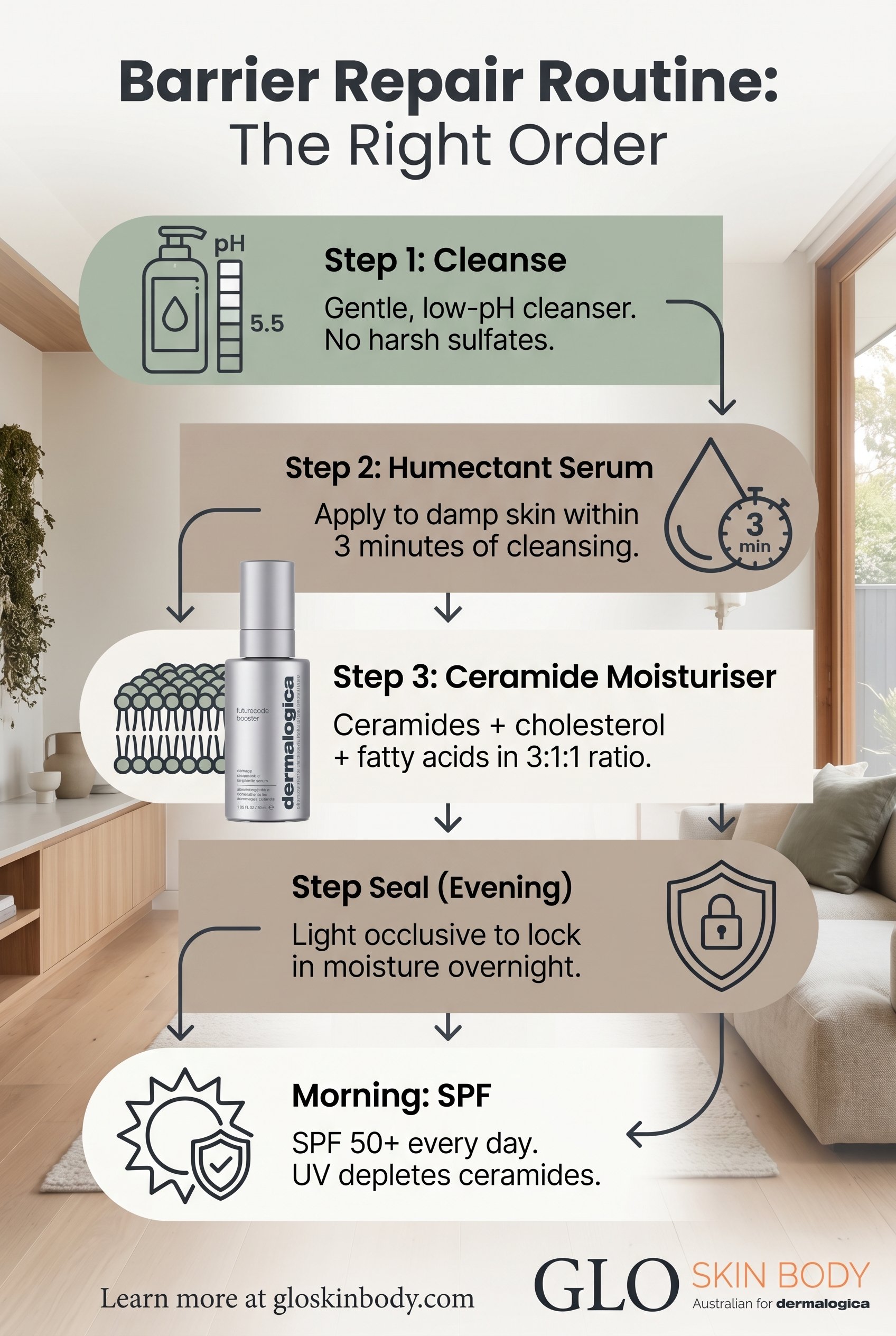
The good news is that this doesn't need to be complicated. A barrier repair routine has a clear logic to it, and once you understand the order, it becomes second nature. Start with a gentle, low-pH cleanser. Harsh foaming cleansers with sulfates raise your skin's pH and disrupt the enzymes that process barrier lipids. Your cleanser should feel comfortable, not squeaky.
While your skin is still slightly damp, apply your humectant serum. Then apply your ceramide-rich moisturiser with that lipid blend. In winter or in air-conditioned environments, add a light occlusive layer on top in the evening.
Morning routine gets SPF on top, every single day. Australian UV doesn't take winter off, and UV exposure is one of the main things that depletes ceramides over time. Daily SPF is non-negotiable for barrier health, not just sun protection.
Expect 4 to 6 weeks before you notice real change. That post-cleanse tightness often eases first, around weeks 2 to 3. Visible texture improvement and better product tolerance usually follow by week 4 to 6. Barrier repair follows your skin's natural renewal cycle. It takes time, and that's completely normal.
If your skin has felt tight, uncomfortable, or just 'off' for a while. And nothing has quite fixed it, there's a good chance your barrier needs more than moisture. It needs the actual building blocks to rebuild: ceramides, cholesterol, fatty acids, humectants applied at the right time. And protection from the environmental stress that keeps depleting what you're trying to restore.
This isn't about finding the perfect product. It's about understanding what your skin actually needs right now, and giving it that consistently over time. If you'd like help mapping out a routine that makes sense for your skin, our personalised skin guidance is a good place to start. You don't have to figure this out alone.


